"Thank You for the Question": 25 Years of Answers, Counted
Published 2026-11-06 · 3 min read
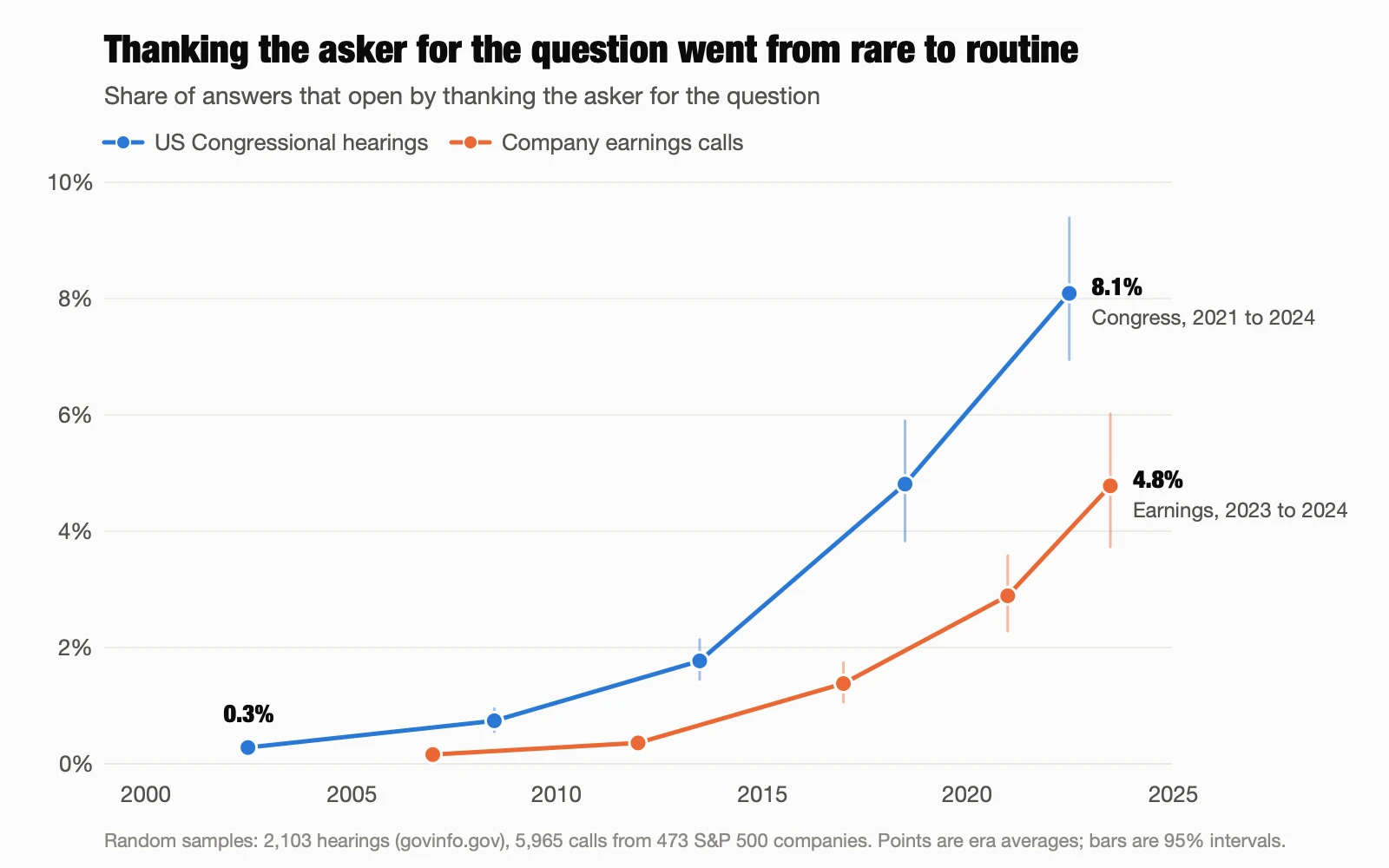
In our sample of US Congressional hearings, 0.28% of witness answers opened by thanking the asker for the question in 1999 to 2006 (87 of 30,730). In 2021 to 2024 it was 8.09% (1,557 of 19,239), about 29 times as common. In our sample of company earnings calls, it went from 61 of 38,621 executive answers in 2005 to 2009 to 1,011 of 21,164 in 2023 to 2024.
That's all this count shows: the opening got common. It counts a phrase, so it can't say why people use it, and it says nothing about the answer that comes after.
The numbers by era
The eras are wide on purpose. Single periods in these samples are small and bumpy, so the comparison that holds up is early against recent, inside each source.
| In our sample | Early era | Recent era |
|---|---|---|
| Hearing answers that open this way | 0.28% (87 of 30,730), 1999 to 2006 | 8.09% (1,557 of 19,239), 2021 to 2024 |
| Hearings with at least one | 11.1% (67 of 602) | 79.3% (261 of 329) |
| Earnings call answers that open this way | 0.16% (61 of 38,621), 2005 to 2009 | 4.78% (1,011 of 21,164), 2023 to 2024 |
| Earnings calls with at least one | 5.7% (47 of 827) | 52.9% (398 of 752) |
Ranges from resampling, at 95%: hearings 0.21% to 0.37% and 6.95% to 9.39%, resampling whole hearings; earnings calls 0.09% to 0.25% and 3.73% to 6.02%, resampling whole companies.
How each source was counted
The two sources use different phrase rules, so read each line against itself over time and don't compare one line's height with the other's.
Congressional hearings. Hearing transcripts come from govinfo.gov, drawn at random within each Congress from the 106th to the 118th: 2,103 hearings, 107,164 witness answers to a member's question. It's a match when the first 20 words hold a thanks ("thank you", "thanks", "I thank you" or "appreciate"), then "for", "the", "that" or "your" within 25 characters, then "question" or "questions" within 12 more, all in the same sentence. Hearing transcripts are US government work.
Earnings calls. These come from a public dataset of S&P 500 earnings call transcripts, in random pulls: 5,965 calls from 473 companies, 221,781 executive answers. The eras on this page hold 5,859 of those calls, and the rest fall outside their years. The rule here is narrower. It's a match when the first 15 words hold "thank you for" or "thanks for" ("very much" or "so much" allowed in the middle), or "appreciate", directly before "the question", "that question" or "your question". It's unsettled who owns these transcripts, so this page publishes counts from them and nothing else.
What the samples can't tell you
- The earnings sample is clustered by company. Calls from one company aren't independent draws, so 752 recent calls from 150 companies are worth less than 752 separate picks. That's why the ranges resample whole companies. The rise also shows inside companies: of the 57 with 100 or more answers both before 2013 and after 2020, 49 rose, 2 fell and 6 stayed flat.
- The earnings set leans toward today's large companies. It's an S&P 500 set, so it shows the companies that made it this far.
- Hearing transcripts may have got more word for word. One rough sign is how often "you know" gets typed, per 1,000 words: 0.66 in 1999 to 2006 and 1.96 in 2021 to 2024, about 3 times as often, while the phrase rose about 29 times. That's one rough sign, and it can't size the effect of typing changes. This check wasn't run on the earnings set, so typing changes there are untested.
- A few hearings could skew a sample like this. Here the 5 hearings with the most matches hold 8.5% of the 1,557 matches in 2021 to 2024, so the figure doesn't hang on a few hearings.
The data
The counts by era, as a CSV. It holds counts only, with no transcript text, and no witness, member, executive or company in the data is named in it or on this page.
I created GlideRail, a Mac app that keeps what you prepared on your side of the screen during calls. It had no part in this count.